Saturday, October 26, 2013

October 28, 2013 - November 2, 2013 Weekly Agenda for 9th Grade Honors English

Monday, October 28th:
Present your word study for the vocabulary in Unit 2.
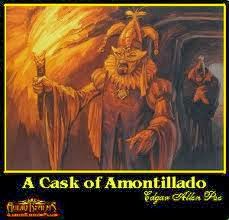
Go over the irony portion of your vocabulary and language packet of "The Cask of Amontillado".

Tuesday, October 29th:
Construct an irony chart for the situational, verbal and dramatic irony demonstrated in the story, "The Cask of Amontillado".  Identify the events, the situations, or the dialogue in the story and then categorize them under one of the three types of irony on your chart.  Make sure you identify who the speaker is and the specific situation and event you are referring to.  Finish for homework tonight. This will be due on Wednesday, October 30th.

We will continue working on the vocabulary and language packet of "The Cask of Amontillado".

Wednesday, October 30th:
Your irony chart for "The Cask of Amontillado" will be due today.
We will continue working on the vocabulary and language packet of "The Cask of Amontillado." Please finish the packet for homework tonight.  This will be due on Thursday, October 31st.

Carefully analyze the short story "The Cask of Amontillado" for clues as to why Montresor hates Fortunato.  Then using your best writing, construct a short two paragraph essay to explain why  Montresor bears a grudge against Fortunato.  Make sure you include evidence from the short story to support your thesis. Also be aware that Montresor is an unreliable narrator and is clearly insane.
This will be due on Friday, November 1st.

Thursday, October 31st:
The vocabulary and language packet of "The Cask of Amontillado" will be due today.
Continue analyzing the short story and working on the two paragraph essay.

Read the biography of Edgar Allen Poe and the article on the last twenty-four hours of Poe's life.

Friday, November 1st:
Finish reading the article on the last twenty-four hours of Poe's life.


Saturday, October 19, 2013

Essay Prompts for "The Necklace" by Guy de Maupassant


"The Necklace:

Has Madame Loisel's character changed at the end of the story?  Why or why not? Support with evidence from the story.

Did Madame Loisel's character contribute to her own downfall?

Analyze the theme of deception - of oneself as well as of others - and the role deception played in Madame Loisel's downfall.

Explore the use of point of view to create the ironic impact of the story.

Possible themes for the story:

Life Doesn't Always Turn Out the Way One Expects.

Character is Destiny.   One's character will determine one's fate.

October 21, 2013 - October 25, 2013 Weekly Agenda for 9th Grade English


Monday, October 21st: 
Your rough draft of the compare and contrast essay of “The Necklace” and “The Gift of the Magi” is due today.  
We will do peer editing today so please be sure to have five paragraphs ready. 

Tuesday, October 22nd: 
Your final draft of the compare and contrast essay of “The Necklace” and “The Gift of the Magi” is due today. 
Read “The Cask of Amontillado” by Edgar Allen Poe
Pass out vocabulary and writing packet for “The Cask of Amontillado”; this will be due on Monday, October 26th. 

Wednesday, October 23rd: 
Finish reading “The Cask of Amontillado”
Discussion
Work on the vocabulary and writing packet for “The Cask of Amontillado”. 
Construct an Irony Chart on "The Cask of Amontillado". 

Thursday, October 24th: 
Assignment: 
Do close reading of the text and surmise why this unreliable narrator, Montresor, may harbor such hatred for Fortunato. Write a three paragraph essay giving possible reasons why Montresor hates him. Be sure to include specific things Fortunato says to or implies about Montresor as evidence to support your writing. 

VOCABULARY WORKSHOP: Level C; Unit 2 is due today. Break into groups of four, choose five words and create a scene, a rap, a song and a dance using all five of the words. Make sure that all the words are used in grammatically correct sentences and that the meanings are clear through the context of the sentence, the rap or the lyrics. 

Friday, October 25th: 
Continue working on the vocabulary sound study.


Monday, October 14, 2013

October 14, 2013 - October 18, 2013 9th Grade Weekly Agenda


Monday, October 14, 2013
Compare and Contrast Essay:
You may work together in pairs. Turn to page 159 for “The Necklace” and to page 287 for “The Gift of the Magi” and construct a “T-graph” or a Venn Diagram to compare and contrast the two women, Madame Loisel in “The Necklace” and Della in “The Gift of the Magi”.  The graphs should illustrate how the women are similar and how they are different.
Final presentation of “Continuing the Story: What Happens Next in ‘The Necklace’”?
Tuesday, October 15th:
Shortened Day: Dismissal time is 1:33
Discussion of your findings of the differences between the two female protagonists.
Go over the essay format for the compare and contrast essay.
Begin working on the rough draft.

Wednesday, October 16th:
Shortened Day: Dismissal time is 2:24
No 1st period today.

Thursday, October 17th:
Rough draft is due. Peer editing.

Friday, October 18th:
Minimum Day: Dismissal time is 12:36
Final draft is due today.
VOCABULARY WORKSHOP: Level C; Unit 2 is assigned and will be due on Thursday, October 24th.
Vocabulary Word Study: Break into groups of four; choose five words and create a song and dance, a rap, or a scene using the five words correctly.


Friday, October 04, 2013

October 7, 2013 - October 11, 2013 Weekly Agenda for 9th Grade English

Monday,  October 7th:
Work on the "The Necklace" vocabulary packet.

Identify the passive sentences in "The Necklace". Analyze the reason de Maupassant uses the passive voice in describing Madame Loisel.  Change the passive voice to active voice; note if there is a difference in the feel of the sentence.

"Continuing the Story: What Happens Next?"
Break into groups of four
Beginning with the last line of the story, "Oh, my poor Mathilde. But mine was imitation. It was worth at the very most only five hundred francs....", continue the story.  What happens next? What does Mathilde say to Madame Forestier?  Is there a resolution to the story where Jeanne gives the necklace to Mathilde, or does she refuse to return the necklace? Has Jeanne sold or given away the necklace and no longer knows where it is?  Use your imagination in resolving this story.

The story should be in short story format with dialogue.  You will present this on Wednesday, October 9th as a group.

Tuesday, October 8th:
"The Necklace" packet is due

Work on "Continuing the Story: What Happens Next?"

Wednesday, October 9th:
Present "Continuing the Story: What Happens Next:?"
Begin reading "The Gift of the Magi"

Thursday, October 10th:
Begin working on a compare and contrast essay between "The Necklace" and "The Magi".
Begin work on a Venn Diagram comparing the two characters.

Friday, October 11th:
Work on the format
Work on the rough draft.
The rough draft will be due on Monday, October 14th for peer editing.
The final draft will be due on Tuesday, October 15th.


Friday, September 27, 2013

September 30, 2013 - October 4, 2013 Weekly Agenda for 9th Grade English


Monday, September 30th: 
Rubrics for “The Most Dangerous Game” Board Game. Worth 100 points.
1. The game may take any form: Monopoly, Trivial Pursuit, Jeopardy, but must relate directly to the story
2. Must include questions posed with the correct answers in order to advance
3. If the player does not know the answer, the player loses a turn:
For example: The player falls into the Burmese Tiger Pit; in order to get out of the Tiger Pit, the player must answer the following question, “Is Rainsford falling over board an example of exposition or rising action?” If the player gives the wrong answer, she must lose her turn and stay in the Tiger Pit.
4. By the end of the period, one must have:
            a. the format
            b. the rules
            c. ten questions and the answers
5. The game must be finished by Wednesday, October 2, 2013.

For Homework, due Wednesday, October 2nd:

HOLT HANDBOOK; pages 44 – 47
1. Page 44, exercise 4; “Writing Complete Sentences”: Write out the sentences and write complete subjects to complete the sentences.
2. Page 46, exercise 5; “Identifying Complete Predicates and Verbs”: Write out the entire sentences and double underline the verb and underline the complete predicate.
3. Pages 46 - 47, exercise 6: “ Writing Complete Sentences”: Using the phrases, add predicates to make complete sentences.
4. Page 47, Review A: Distinguishing Between Sentence Fragments and Sentences; Identifying Subjects and Predicates”: Identify the sentence with an “S” , or a fragment with an “F”, Write the simple subject, underlining it once and write the simple predicate, underlining it twice.

Tuesday, October 1st: 
4th, 5th, 6th and 7th only today. 

Wednesday, October 2nd: 
"The Most Dangerous Game" Board Game is due today. 
Your grammar homework from the HOLT HANDBOOK is due today.

Thursday, October 3rd: 
Read "The Necklace"

Friday, October 4th: 
Go over the vocabulary and irony packet for "The Necklace". 
Work on "Continuing the Story: What Happens Next?'  
Taking the last line from the story, begin your own story of what follows next in Madame Loisel's life. This should be two pages, and incorporate the characters of the Loisels and Madame Forestier in the stories. 


Sunday, September 22, 2013

SEPTEMBER 23, 2013 - SEPTEMBER 27, 2013 WEEKLY AGENDA for 9TH GRADE ENGLISH


September 23, 2013 – September 27, 2013 Weekly Agenda for 9th Grade Honors English
Monday, September 23rd:
Finish up the Freitag Pyramid for “The Most Dangerous Game” plot.
Review the following terms:
Antagonist, protagonist, setting, mood, metaphor, simile and imagery
Conflict:  Person vs. Person,
                Person vs. Nature
                Person vs. Self
                Person vs. the Supernatural
For homework tonight, finish up “The Most Dangerous Game”

Tuesday, September 24th:
“The Most Dangerous Game” vocabulary, grammar and suspense handout is due today.

Please bring your HOLT HANDBOOK to class.  The Parts of the Sentence, pages 40 - 47; exercises 1- 3.  The grammar homework will be due on Thursday, September 25th.             

Begin work on the essay for “The Most Dangerous Game”
The essay prompt is: How does Richard Connell use setting, mood and character to reveal the theme that “The World Is Divided into Two Categories: the strong and the weak, and the strong have the right to prey upon the weak. Does the ending support or challenge the theme? What does Connell seem to be saying about the belief that the strong have the right to prey upon the weak?

Begin work on your Cornell Notes for “The Most Dangerous Game”
Find  at least three relevant quotations for  your essay
Explain in  your own words why and how the quotation supports your thesis statement.

Wednesday, September 25th:
Work on your rough draft in class.


Thursday, September 26th:
Your rough draft will be due today.
We will break into groups of four and do peer editing on the rough draft.
The grammar homework is due today. Pages 40 - 47; exercises 4, 5 and Review will be assigned and due on Tuesday, October 1st. 

Friday, September 27th:
Your final draft will be due today.
If everyone turns in her/his final draft today, we will spend Friday and Monday working on a board game for "The Most Dangerous Game" (a la "Monopoly")
Otherwise: 
Begin reading "The Necklace" by Guy de Maupassant


Sunday, September 15, 2013

September 16, 2013 - September 20, 2013 Weekly Agenda for 9th Grade Honors English

Monday, September 16th: 

Finish reading "The Most Dangerous Game"
Reading log 
Go over the vocabulary, suspense and grammar packet for "The Most Dangerous Game" 

Tuesday, September 17th:

Go over Freitag's plot line:
Exposition, Rising Action, Climax, Falling Action, Denouement
Go through "The Most Dangerous Game" and place the events in the short story on Freitag's plot line

Wednesday, September 18th: 

Periods 1 - 4 do not meet today

Thursday, September 19th:

How to Find the Theme of a Story

Essay: 
Do you think  the author, Richard Connell,  of the short story, "The Most Dangerous Game",  answers the question posed by the theme: "The world belongs to the strong, and the weak are placed in the world to be used by the strong."

Work on the essay in class. 

Friday, September 20th: 

Your rough draft will be due today. We will do peer editing.  
The final draft will be due on Monday, September 23rd. 


Saturday, September 14, 2013

September 9, 2013 - September 13, 2013 Weekly Agenda for 9th Grade Honors English

Monday, September 9th: 

Peer Editing for "The Sniper" essay
Break into groups of four.
Pass your paper to the person sitting to your left.
Each person in the group will edit one paragraph according to the posted rubric.

Tuesday, September 10th:

"The Sniper" essay is due today.
Pass out Engrade access codes
Pass out syllabus for class
Go over answers to Unit One Vocabulary

Wednesday, September 11th: 

Begin reading "Most Dangerous Game"
Reading logs
Mood, setting, tone

Thursday, September 12th: 

Continue reading "Most Dangerous Game"
Discussion
Reading Logs
Literary Analysis
Character Analysis
Vocabulary

Friday, September 13th: 

Passed out vocabulary, suspense, and grammar packet for "The Most Dangerous Game" 
Continue reading "Most Dangerous Game"
Reading logs 

Friday, September 06, 2013

Essay Outline for "The Sniper"


Outline for “The Sniper” Essay
Opening Paragraph:
1. Must include title (with quotation marks) and the name of the author
2. Must include a thesis statement
3. Briefly summarize the story  (no more than one to three sentences)
4. One sentence each to show what each paragraph is going to be about.
5. Transitional sentence which segues to next paragraph

First, Second and Third Body Paragraphs:
Mini-topic sentence to show what this paragraph is about.
Two to four sentences to develop the mini-topic sentence
Evidence pulled from the story or quotations to support your mini-topic sentence
In your own words show how this evidence and/or quotation supports your thesis.
Transitional sentence which segues to next paragraph

Conclusion:
Go over the points you made in the first, second and third body paragraphs. There should be one sentence per point or paragraph.
Show how the author was successful in supporting his theme. 

CORNELL NOTES

How to Do Cornell Notes:

Draw a vertical line down the page about one third of the way from the left. Then about three-quarters down the page draw a horizontal line from margin to margin.

On the left side of the vertical line, write quotations and/or paraphrase of the events in the story.

On the right side of the vertical line, write your commentary, analysis and/or your explanation of the quotation or paraphrase.

Under the horizontal line, write a brief summary of the plot, the theme of the story and/or any other important aspect of the story: setting, characters, etc.

This will provide you with the needed information to write your essay. The quotations and your analysis will provide the bulk of your body paragraphs.  You just have to clean them up a bit, put them in fancy grammatical clothes and in the right paragraph format and your essay is half way finished!


Sunday, September 01, 2013

September 3, 2013 - September 6, 2013 Weekly Agenda for 9th Grade Honors English

Tuesday, September 3rd: 

Essay prompt for "The Sniper":

How does the author use the third person limited point of view and other literary techniques  to advance the theme in "The Sniper"?

You will be given time in class to complete your essay.

If time permits, we will break into groups to do peer editing.

The final draft will be due on Friday.

Friday, September 6th: 

Your final draft will be due today. 

Begin reading "The Most Dangerous Game"

What is a Theme?


TOWARDS the EXAMINED LIFE

This is by Thomas Trevenen from his blog TOWARDS the EXAMINED LIFE.  This is so good I decided to post it to my blog for my students to read.  I hope he doesn’t mind. 

What is a Theme?
(Or What is the Story About?)

Objective:  After this lesson, we shall this vow:

“From this day onward, whenever anyone asks us what a story or movie or tv show or play was about, we will not mention the plot or the characters unless it is to prove what we say is true.” 

What makes a story true?

Take the story of Humpty-Dumpty. There was no Humpty Dumpty.  There was no wall and no horses. No men. It didn’t happen. But it is true. How can this be? 

It is true because we recognize that sometimes a person can have a crisis that is so devastating that the damage will never be repaired to the point where the life was before.  Regardless of any repair that might be done, the life will never be the same as it once was.  This is what Humpty Dumpty is all about, but notice I have not mentioned the plot of the story. 

What is the truth of a story? It is in the theme. 

The theme of a work is the central idea behind it.  The plot and the characters and the setting and the mood and the tone and all other important parts of the plot are simply vehicles to express the theme.

What is the movie Titanic all about? It is about how love can surpass boundaries such as class, time and even death. It is about how love can give meaning and purpose to life. Look at the movie. Isn’t this some of what the movie is about?  Aren’t these ideas put forth through the plot and setting of the movie? And there are more ideas put forth in the movie. Isn’t it also about the nobility of human beings in difficult situations? Isn’t it about strength of character is not determined by social standing? Please note that ideas and not characters or particular situations are being discussed. If any part of a thesis must be proved, then elements of the plot can be taken out to to support the ideas of the theme. 

What makes a piece of literature or film great is often the strength of its theme. The more complex and revealing the ideas are, the more the reader learns about life.  The more valuable the lessons, the more enduring the work. Moby Dick is not great for its plot which bogs down in many places but for its themes about the nature of humanity and existence.  The search for the great white whale can really be about the search for the meaning of life and the forces that control it.  Is it the great white whale Ahab seeks or is it the force of creation that wears the mask of the whale. And what does that last sentence mean, anyway? These are a minute fraction of what the novel is about. 

Themes should be stated in terms of “may be’s” and “could be’s”.  Themes are not absolute science.  The theme does not happen “always” and “every time”.  Themes are possible events that may happen in certain circumstances because there is recognition that life is a complex, sophisticated experience with many possibilities. Try this theme of Mice and Men by John Steinbeck.

Life lived alone, friendless and without attachments can sometimes be a painful thing. When one finds companionship of a single human being, the quality of life can be improved dramatically. Sometimes, however, there will be forces of society and nature that will place a strain on the relationship. These forces may attempt to rend the friendship apart.  However, the value of the friendship may be that it allows for the beginning of dreams of a better future where people will be allowed to grow and live happily. If the opposing forces are too strong the friendship may be destroyed even to the point where one person will be made to sacrifice the dream and destroy the friend he loves in order to protect his friend from even greater harm. 

Or try to this set of notes from a really interesting group of students who discussed the theme of the “The Sweetheart of the Song Tra Bong” from The Things They Carried by Tim O’Brien. 

Sometimes a person can become lost in the savagery and excitement of war. If the person doesn’t find the fear involved unpleasant, the excitement could be enjoyable.  The person can actually enjoy war.  The person can even love the war. The person can enjoy the danger and risks of war....and may want to become a part of it.  In...war, everyone is part of a team and gains respect for who each person is....and what each person does.  A person might not want to lose the power by going home. The person might not want to lose what she or he has become. 

Notice the things the students did that was really well done. They started out slowly with an attempt to state what the story was about. With each succeeding sentence they delved a little deeper into the reasons why a person “become lost in the savagery and excitement of war”.  With each step they took, they made sure that the general thought about becoming lost in the savagery and excitement of war was supported by the plot of the story. Now the students’ explorations of theme is not a well-written paragraph; it is just notes for a future paragraph, but one can see the progression of thought involved.  They did not mention the plot, but in a written assignment [the theme] can be supported by the plot of the story. 

Saturday, August 24, 2013

The Sniper Discussion Questions

The Sniper: Discussion Questions

Read the questions below.  For each question, write a clear, direct and complete response.  Answer each part of the question. Use complete sentences. Use names of characters or distinct labels - avoid pronouns.

1. The sniper is described as a fanatic. A fanatic is a person whose interest in something or someone is irrational and intense. What is the sniper fanatical about? What does the author's use of the phrase "cold gleam" imply?

2. What risk did the sniper take? Why do you think he took this risk?

3. Why did the sniper shoot the unarmed woman? Was he justified? Explain why or why not. What does this action reveal about the sniper's personality? Explain.

4. The author uses vivid imagery and description. Write as many descriptive words or phrases you can find which help the read to see and feel what the sniper is experiencing.

5. Why must the sniper leave the roof? Why can he not leave yet? Why can he not use his rifle?

6. After killing the enemy, the sniper's attitude has changed.  Describe the reactions - both emotionally and physically - of the sniper. Why do you think he has reacted in this way? What do these reactions reveal about the emotional state of the sniper?

7. Aside from curiosity, why does the sniper want to see the face of the other sniper?

8. Identify three qualities that make the two snipers alike beyond being brothers.


August 26, 2013 Weekly Agenda for 9th Grade Honors English

Monday, August 26th:
Go over the verb section of "The Sniper" packet. Finish the packet for homework. This will be due on Tuesday.
Break into groups and finish writing your pov short story based on "The Sniper".
Begin presenting the short story.

Tuesday, August 27th:
Finish the presentations of the pov rewrites of "The Sniper".
"The Sniper" vocabulary, grammar and irony packet is due today.

Wednesday, August 28th:
You will be given questions about "The Sniper" as a group to answer.
You will then present to the class your opinions. Remember, every answer must be supported by the text directly or through inference.

Thursday, August 29th:
Today we will begin work on an essay on "The Sniper".  The prompt is: How does the third person limited point of view affect the theme of "The Sniper?  This will be due on Tuesday,  September 3rd.


Tuesday, August 20, 2013

August 19, 2013 - August 23, 2013 Weekly Agenda for 9th Grade Honors English


Monday, September 19th:

Assign VOCABULARY WORKSHOP: Level C; Unit One. This will be due on Friday, September 23rd.
Break into groups and read nonfictional historical information regarding the Irish and British conflict.

Tuesday, September 20th:
Group presentations of nonfictional historical information about the Irish and British conflicts.
Read “The Sniper”
Readings logs for “The Sniper”

Thursday, September 22nd:
Finish reading “The Sniper”
Pass out and go over the “The Sniper” vocabulary and irony packet. This will be due on Tuesday, September 26th.

Friday, September 23rd:
Break into groups, choose a character to rewrite the story from the pov of that character. You will present the scene to the class.

Friday, June 07, 2013

June 3, 2013 - June 7, 2013 9th Grade Honors English


Monday, June 3rd:
Act 4 Test, Grammar Packet and Vocabulary Packet due today!

Pass out Act 5 Test and Vocabulary Packet. This will be due on the day of the final, June 5th. 

Read Act 5, Scenes 1, 2, 3

Break into groups of four.  Choose one scene from the following and rewrite in modern contemporary English. You will present on the day of the final, Wednesday, June 5th.


FINAL


1ST GROUP:

ACT 1, SCENE 1: pages 788 – 790

Karla, Isabel, Renatta, Mayra


2nd GROUP:

ACT 2, SCENE 4: pages 833 – 835

Elizabeth, Brenda, Samantha


3rd GROUP:

ACT 3, SCENE 2: pages 846 – 850

Robert, Ake, Christian, Ricardo


4th GROUP:

ACT 4, SCENE 5: pages 870 – 873

Melissa, Daniel, Vicki, Amanda


5th GROUP:

ACT 5, SCENE 3: pages 901 – 904

Justin, Angie, Josine, Pamela

May 20, 2013 - May 24, 2013 9th Grade Honors


Monday, May 20th:
Read ROMEO and JULIET, Act 3

Tuesday, May 21st:
Field trip to see JOE TURNER'S COME and Gone at the Mark Taper Forum

Wednesday, May 22nd:
Reread pages 845 - 846; lines 1 -70
Use these questions to help you analyze the scene:
1. What does Benvolio suggest he and Mercutio do and why?
2. What kind of fellow is Mercutio claiming Benvolio to be and why?
3. Does Mercutio really believe what he is saying about Benvolio or is he joking?
4. Which person do you think Mercutio is really describing? Do you think he would agree?
5. What are the three things Mercutio is accusing Benvolio of fighting about?
6. There is foreshadowing in lines 30 - 31? What is it foreshadowing?

Class discussion

Thursday, May 23rd:
 Reread and act out the Mercutio and Tybalt scene.
Discussion: comprehension, character, etc.
Passed out Act 3 test and vocabulary packet. Go over the vocabulary. 

Friday, May 24th:
Reread pages 850 - 852 in ROMEO and JULIET
Class discussion: Vocabulary, Comprehension, Characters, Motivation, Plot Points
Vocabulary:
Amerce: to punish
Kinsman: relative
Slew: past tense form of word to slay (to kill); killed
Reread Act 3, Scene 2
Juliet's soliloquy
Analyze what she is saying; share with class
Look for allusion used by Juliet; share with class
Look for personification used Juliet; share with class
Look for irony and paradox used by Juliet; share with class
Class discussion
How and why does Juliet use oxymorons to express her ambivalence towards Romeo when the Nurse (finally) tells her that Romeo is alive but that he killed Tybalt?
Look for imagery and metaphor used by Juliet

Sunday, May 12, 2013

May 13, 2013 9th Grade Honors English


May 13, 2013 - May 17, 2013
Weekly Agenda for 9th Grade Honors English

Monday, May 13th:
The following are due today:
The ROMEO and JULIET essay
Act 2 Reading Logs
Act 2 ROMEO and JULIET Test

Tuesday, May 14th:
Literary Analysis District Assessment

Wednesday, May 15th:
Literary Analysis District Assessment

Thursday, May 16th:
Literary Analysis District Assessment

Thursday, May 09, 2013

How to Write the Intro, the Body Paragraph and the Concluding Paragraph


Essay on Light and Dark Imagery in ROMEO and JULIET.

In the opening paragraph you need to write the title (and underline it) and the name of the author.  You need to write the main idea of the essay.

William Shakespeare, the author of the play ROMEO and JULIET, uses light and dark imagery to express the emotional state of Romeo, one of the star-crossed lovers in his masterpiece.   Romeo is in a dark and depressed state because he is suffering from unrequited love. He is in love with a young woman named Rosaline who doesn’t love him back. His speech and behavior reflect his dark mood.  It is not until he meets and falls in love with the beautiful Juliet that his speech and behavior change to reflect his joy and happiness.

(Provide context in this paragraph. What is going on with Romeo at the beginning of the play?)  He is suffering from unrequited love.  He is in love with a young woman named Rosaline who doesn’t love him back.  His speech reflects his dark mood. It is not until he meets Juliet and falls in love with her, that his language changes to expressions of light, joy and happiness.

At the beginning of ROMEO and JULIET, we find his parents, Lord and Lady Montague,  and his best friend, Benvolio, worrying about the emotional state of Romeo.  Benvolio tells Romeo’s parents that he has seen Romeo walking alone at night “…so early walking did I see your son”, but Romeo is so depressed that he has been turning away from his best friend to avoid speaking to him.  Lord Montague also expresses concerns about his son’s emotional health for he says that his son cries a great deal “…With tears augmenting the fresh morning’s dew”, and that as soon as the sun rises, Romeo, “Away from light steals home…Shuts up his windows, locks fair daylight out, And makes himself an artificial night.” Romeo is clearly depressed for he spends the night walking about alone, avoiding even his best friend, and when the sun rises, he shuts the curtains and sits in darkness, crying.  Isolation and excessive crying are all symptoms of deep depression, and the words and imagery used to describe Romeo strongly convey the mood of darkness and heaviness. Lord Montague at one point even calls Romeo his "heavy son." There is grave cause for concern regarding Romeo's emotional health and the Montagues prevail upon Benvolio to find out why Romeo is so depressed.
-->

The Montagues ask Benvolio, as Romeo’s cousin and best friend, to find out why their son is so depressed.   When they spot Romeo approaching after the riots, the parents retreat, leaving Benvolio to talk to him for them.  Romeo replies to his friend’s question about his emotional state that, “…such is love’s transgression. Griefs of mine own lie heavy in my breast.” Romeo is suffering from unrequited love.  The girl he loves, Rosaline, loves him not “…She’ll not be hit /With Cupid’s arrow…”  which is the reason he is so depressed. Benvolio counsels Romeo that the cure for an old love is a new love and tells him to check out other girls to help him forget Rosaline.  An opportunity arrives in the form of an invitation to a party which promises the presence of many beautiful girls.  The only problem is that the party is hosted by the enemy of Romeo’s family, the Capulets!


 In Act 1, Scene 4, before entering the party, Romeo is again being quite dark, depressing, and clearly, not in a party mood; he says to his good friends, Benvolio and Mercutio, “Give me a torch. I am not for this ambling./Being but heavy, I will bear the light.” Romeo’s friends are eager to start dancing, but he continues in his depressed vein by saying,” You have dancing shoes/With nimble soles; I have a soul of lead/So stakes me to the ground I cannot move.” His friend, Mercutio, tries to joke him out of his dark heaviness by advising him “If love be rough with you, be rough with love…” At last, Benvolio reminds them that it is getting late and they will miss the party if they tarry too much longer. Romeo says that despite his fears that tonight will initiate a series of events ending in his death “…some misgivings / Some consequences yet hanging in the stars/ Shall bitterly begin his fearful date…of untimely death….” he throws his fate to the stars and enters the house of his enemies.


It is in Act 1, Scene 5, at the party in his enemy’s home that Romeo’s life changes and it is reflected in the language he speaks. As soon as he lays eyes on Juliet, the black clouds surrounding him lift, his life is flooded with light, and his words immediately change from dark, heavy imagery to that of lightness and beauty. He says, “O, she doth teach the torches to burn bright!/It seems she hangs upon the cheek of night/As a rich jewel in an Ethiop’s ear –“ From the veil of darkness, Romeo emerges into the light of Juliet’s love for later, when he sees her walk onto her balcony after the party, he says, “What light through yonder window breaks?/It is the East and Juliet is the sun!” He has immediately forgotten about that follower of Dian, the goddess of chastity, Rosaline, and is now expressing his love for Juliet by exquisite words of light and joy.


 Before meeting Juliet, Romeo tells his friends he cannot dance, for his feet are made of lead and that he “cannot bound a pitch” for he’s too depressed over his lack of love, but after meeting her, Romeo risks certain death by leaping over the tall wall that surrounds his enemy’s mansion to speak to his lady love.  When Juliet wonders how he managed to brook the tall wall,   Romeo tells her, “With love’s light wings did I o’erperch these walls;/For stony limits cannot hold love out.”

Tuesday, May 07, 2013

Format for Writing the Romeo and Juliet Essay


The prompt: 

Write a well-organized essay regarding Shakespeare’s use of light and dark imagery in all of Act 1 and in Act 2, Scenes 1 and 2.  Be sure you include the dark references other characters make regarding Romeo (Benvolio, Mercutio and Romeo’s parents) and what Romeo says about himself.  Be sure you include the change of imagery from dark and heavy to light, in Act 1, Scene 5, after Romeo has met Juliet. 

You must have an introduction which must include a thesis statement.  The introduction should be about half a page. In the introduction, you should include the main points you will be covering in the essay. 

The body paragraphs: 
The body paragraph must have a mini-thesis statement. 
You must develop the mini-thesis statement (a minimum of two or three sentences in your own words). 
You must have a quotation from the text. 
You need to paraphrase and explain what it means and how it relates to the theme of lightness and darkness. This should be a minimum of three sentences.
You need to have a concluding sentence which summarizes the main idea in this  paragraph.

Conclusion: 
In the concluding paragraph, you should recap the points that you covered in the essay, much like you did in the introduction. You should conclude with a sentence that basically sums up the overall theme of the essay. 

Special note: DO NOT WRITE IN CONCLUSION!

Sunday, May 05, 2013

May 6, 2013 - May 10, 2013 Honors 9th Grade English

 Monday, May 6th:
Review figurative language in Act 2, Scenes 5 and 6
Begin work on the essay today

Tuesday, May 7th:
The Vocabulary/Characterization Handouts will be due today.
Work on the ROMEO and JULIET Essay today in class.

Wednesday, May 8th:
Work on the ROMEO and JULIET Essay today in class.
The essay will be due tomorrow

Thursday, May 9th:
The essay, the Act 2 Test and the Act Reading Logs will be due today.
Read Act 3, Scene 1 today
Reading logs
Act out

Friday, May 10th:
Read Act 3, Scene 2, Scene 3
Reading Logs

Sunday, April 28, 2013

April 29, 2013 - May 3, 2013 Weekly Agenda for 9th Grade Honors English

Monday, April 29th:
The essay over the use of light and dark in figurative language will be assigned today.  This  essay will be due on Thursday, May 2nd.
Read Act 2, Scene 3 in ROMEO and JULIET
Analyze the Friar's speech
Read Act 2, Scene 4
Reading Logs
Act out

Tuesday, April 30th:
Pass out the Vocabulary Handout for Act 2
Read Act 2, Scene 5
Reading Logs
Analyze

Wednesday, May 1st:
When we finish Act 2, the Act 2 test for ROMEO and JULIET will be due
Begin reading Act 3, Scene 1
Read and analyze
Reading log
Act out

Thursday, May 2nd:
Begin work on the essay on the use of light and dark in figurative language in ROMEO and JULIET.
Read Act 3, Scene 2
Read and analyze
Reading log

Friday, May 3rd:
Read Act 3, Scene2
Read and analyze
Reading log


Monday, April 22, 2013

April 22, 2013 - April 26, 2013 9th Grade Honors English

Tuesday, April 22nd:
Read ROMEO and JULIET; Act 2, Scenes 1 and 2
Reading log
For homework: Read through the "balcony scene" in Scene 2; find as many examples of metaphor, simile, personification, allusion, alliteration as you can; write them down; list who is speaking and what the character is speaking about; and what the figurative example means literally and figuratively.
Example:
"It is the East and Juliet is the sun!"
Metaphor
Romeo is speaking about Juliet stepping onto the balcony.
He is comparing her to the rising of the sun and it is as if she is the sun which is turning his life into light and a new day.

Thursday, April 25th:
Homework is due today.
Read ROMEO and JULIET; Act 2, Scenes 3 and 4
Reading log
Pass out Act 2 ROMEO and JULIET Test
For homework: 
Go through ROMEO and JULIET and find all the examples of lightness and darkness Romeo refers to from the beginning of the play to Act 2, Scene 3. List all the many references to darkness that Romeo makes about himself, and others make about him in Act 1 until the moment he sees Juliet. Please find all the references Romeo makes to light after he meets Juliet.
Please be aware that this is the preparatory work for a major essay you will be writing for this class.

Friday, April 26th:
Read ROMEO and JULIET; Act 2, Scene 5
Reading Log
Find one quotation you particularly like and illustrate it, using the quotation as a caption.
Begin outline and rough draft of the essay.
Your Act 2 reading log and Act 2 test will be due on Monday, April 29th.  Your essay will be due on Tuesday, April 30th.


Monday, April 15, 2013

April 15, 2013 - April 19, 2013 Weekly Agenda for 9th Grade Honors English

Monday, April 15th:
Go over pages 8, 13 and 14 in CST Prep Packet
Learn dance and rehearse for the presentation of Act 1, Scene 5 in Romeo and Juliet
Begin presentations

Tuesday, April 16th:
Go over CST Prep Packet; pages 20, 21, 22, 23, 24
Your Act 1 Reading Logs are due today.
Finish presentations

Wednesday, April 17th:
Go over CST Prep Packet; pages 27 - 31
Go over Connotation handout
Read ROMEO and JULIET, Act 2, Scene 1
Find examples of figurative language
HOLT HANDBOOK: pages 461 - 462; exercise 6; Parallelism; due Friday

Thursday, April 18th:
Go over CST Prep Packet; pages 40. 41, 42
Go over Parallelism Handout
Assign Unit 7 in VOCABULARY WORKSHOP
Read ROMEO and JULIET; Act 2, Scene 2
Reading logs

Friday, April 19th:
Go over CST Prep Packet; pages 52, 53, 61, 62, 63, 64
HOLT HANDOUT; Parallelism homework is due; pages 461 - 462; exercises 6
Connotation/Denotation: Graphline of Mercurial Personality Type. Class discussion on graphing from the most negative connotation to the most positive connotation of the term: changeable personality.
Assignment: Write two letters, one a letter of recommendation praising a friend for her/his highly organized and attentive personality; the other letter highly critical of the friend for her/his nitpicky, perfectionistic and annoying personality.   Both of these will be due on Monday.
Read ROMEO and JULIET; Act 2, Scene 3
Reading logs

Monday, April 08, 2013

April 8, 2013 - April 12, 2013 Agenda for 9th Grade Honors English

Monday, April 8th:
CST Prep "Helping Hoofs"
Queen Mab Gallery Walk
Divide Act 1, Scene 5 into sub scenes

Tuesday, April 9th:
CST Prep; pages 43 and 44
Divide into groups; create script and rehearse scenes

Wednesday, April 10th:
CST Prep; page 8
Assign Unit in VOCABULARY WORKSHOP; this will be due on Tuesday, April 16th
Rehearse scenes

Thursday, April 11th:
CST Prep; pages 13 and 14
Assign parallelism in HOLT HANDBOOK; this will be due on Wednesday, April 17th.
Make masks
Learn dance for scene

Friday, April 12th:
CST Prep; pages 20 - 24
Perform scenes


Tuesday, March 26, 2013

April 2, 2013 - April 5, 2013 9th Grade Honors English

Tuesday, April 2nd:
CST Review
Review Act 1, Scene 4
Analyze Mercutio's "Queen Mab" speech
Assignment:
1) Find four scenes in the "Queen Mab" speech
2) Read and analyze the "Queen Mab" speech until you can visualize what is being said.
3) Choose four "scenes" in the speech and draw or computer generate or create a collage depicting the scenes.
4) Under the picture, write the lines as a caption.
This is a major grade and will be due on Tuesday, April 9th

Wednesday, April 3rd:
Read Act 1, Scene 5

Thursday, April 4th:
CST Review: "Run for a Better Life"; pages 25-26; "Carrier Pigeons"; pages 18 - 19
Pass out Act 1 ROMEO and JULIET Test; this will be due on Wednesday, April 10th
Pass out the Iambic Pentameter Handout; go over in class tomorrow

Friday, April 5th:
CST Review
Go over the Iambic Pentameter handout
Break into groups to act out Act 1, Scene 5

Monday, March 18, 2013

March 18, 2013 - March 22, 2013 9th Grade Honors English

Monday, March 18th:
Go over adjective clauses in Act 1, Scene 2
Assign the adjective clause handout for homework; this will be due tomorrow!
Briefly review Act 1, Scene 2 for comprehension, vocabulary and figurative language

Tuesday, March 19th:
Shortened day!
Briefly go over Unit 6 homework and Holt Handbook homework
Read Act 1, Scene 3
Review for comprehension, vocabulary, characterization, and figurative language

Wednesday, March 20th:
Act 1, Scene 3 Review
Read Act 1, Scene 4
Review for comprehension, vocabulary, characterization, and figurative language
Analyze "Queen Mab" speech
For homework: choose four scenes from the Queen Mab's speech and create a cartoon. Illustrate the scenes and then write the quotations as captions under the illustration.  This will be due on Friday.  It is for a grade.

Thursday, March 21st:
Read Act 1, Scene 5
Review Act 1, Scene 5 for comprehension, vocabulary, characterization and figurative language.

Friday, March 22nd:
Act out Act 1, Scene 5


Saturday, March 09, 2013

March 11, 2013 - March 15, 2013

9th GRADE HONORS ENGLISH

Monday, March 11th:
Go over Unit 6 in VOCABULARY WORKSHOP: this will be due on Friday, March 15th
Briefly rehearse the rewrites
Begin presenting the rewrites of Act 1, Scene 1

Tuesday, March 12th:
Not a shortened day!
HOLT HANDBOOK; Semi-colons: pages 296 - 300; exercises 1, 2, and Review; this will be due on Wednesday, March 13th.
Finish presenting Act 1, Scene 1

Wednesday, March 13th:
Go over HOLT HANDBOOK grammar homework
Read ROMEO and JULIET; Act 1, Scenes 2 and 3
Reading logs: comprehension, plot, theme, characterization, figurative language

Thursday, March 14th:
Warm-ups: Write five sentences with adjective clauses using five words from Unit 6
Continue with Scene 3
Reading logs: comprehension, plot, theme, characterization, figurative language

Friday, March 15th:
Unit 6 VOCABULARY WORKSHOP is due today.
Read ROMEO and JULIET; Act 1, Scene 4
Reading logs: comprehension, plot, theme, characterization, figurative language


Sunday, March 03, 2013

March 4, 2013 - March 8, 2013 Agenda for 9th Grade Honors English

Monday, March 4th:
Go over Holt Handbook homework; Sentence Fragments
Analyze Act 1, Scene 1 for figurative language, comprehension, plot, characterization
Oxymoron handout
Act out Act 1, Scene 1
Reading Logs

Tuesday, March 5th:
Read and analyze Act 1, Scene 2 of ROMEO and JULIET for comprehension, plot, characterization vocabulary and figurative language
Act out
Reading Logs

Wednesday, March 6th:
Please bring your HOLT HANDBOOK; Semi-colons; pages 296 - 300; exercises 1, 2 and Review  will be assigned; due Friday, March 7th.
Read and analyze Act 1, Scene 3 of ROMEO and JULIET for comprehension, plot, characterization vocabulary and figurative language
Act out
Reading logs

Thursday, March 7th:
Please bring Vocabulary book; Unit 6 will be assigned; due Tuesday, March 12th

Read and analyze Act 1, Scene 4 of ROMEO and JULIET for comprehension, plot, characterization, vocabulary and figurative language
Act out
Reading logs

Friday, March 8th: 
Your grammar homework will be due today
Read and analyze Act 1, Scene 5 of ROMEO and JULIET for comprehension, plot, characterization, vocabulary and figurative language
Act out
Reading logs